Blogs / Diwali Gifts and Hampers: Why Eco-Friendly Matters
Diwali Gifts and Hampers: Why Eco-Friendly Matters
Diwali falls on Sunday, 8 November, and gift and hamper shopping is already picking up. Most people pick by how a hamper looks in photos, and most procurement teams pick by price per unit. Neither group usually asks what happens to the box after it’s opened. This year there’s a sharper reason to ask anyway.
What one gift wrapper adds up to
Take Nagpur. After Diwali in 2024, the city’s sanitation department told local reporters that waste collection jumped by more than 200 tonnes in just two days, against a typical load of about 77 tonnes a day from markets and 64 tonnes from street cleaning. That’s not a one-off. It’s what happens when a few days of concentrated gift-giving, wrapping paper, foil, and packaging meet a city’s normal collection capacity.
Zoom out and the pattern holds nationally. A February 2026 NITI Aayog sectoral report puts India’s municipal solid waste at roughly 101 million tonnes a year, with 61% of it ending up in landfill rather than composted or recycled. A festival that concentrates a chunk of the country’s annual gift-giving into about a week doesn’t create that number by itself. But it adds a visible spike on top of it, in the one week it’s hardest for a sanitation crew to miss.
Why the math changes for a corporate order
One gift wrapped in plastic film is a small decision. Five hundred identical ones, ordered for employees or clients and wrapped the same way, is a different decision entirely, just repeated at scale. The packaging rules we’ve written about before apply to exactly this kind of volume: producers, importers and brand owners of plastic packaging now sit inside an EPR compliance chain, and a procurement team ordering branded plastic hampers by the hundred is buying into that chain whether or not anyone mentions it at checkout.
There’s also a slower structural shift happening above procurement’s head. SEBI has required India’s 1,000 largest listed companies by market capitalisation to file an annual Business Responsibility and Sustainability Report since FY 2022-23. Separately, under Section 135 of the Companies Act, any company crossing Rs 500 crore net worth, Rs 1,000 crore turnover, or Rs 5 crore net profit has to spend at least 2% of its average net profit on CSR. Neither rule mentions gift hampers by name. But both mean more companies than ever have someone whose job includes asking where the budget and the packaging ended up, and a Diwali gifting line item doesn’t get a quiet pass just because it’s small.
What “eco-friendly” should mean on a hamper
“Eco-friendly” on a hamper should name an actual material, seed paper, kraft, cloth or steel, not just sit as a word on a box wrapped in cellophane with a leaf printed on it. The packaging has to match that claim, and ideally you can ask who made the thing and get a real answer back. We’ve gone deeper on spotting the difference between a real claim and a decorated one in an earlier guide, if you want the longer version.
What this looks like at Eco Happy this Diwali
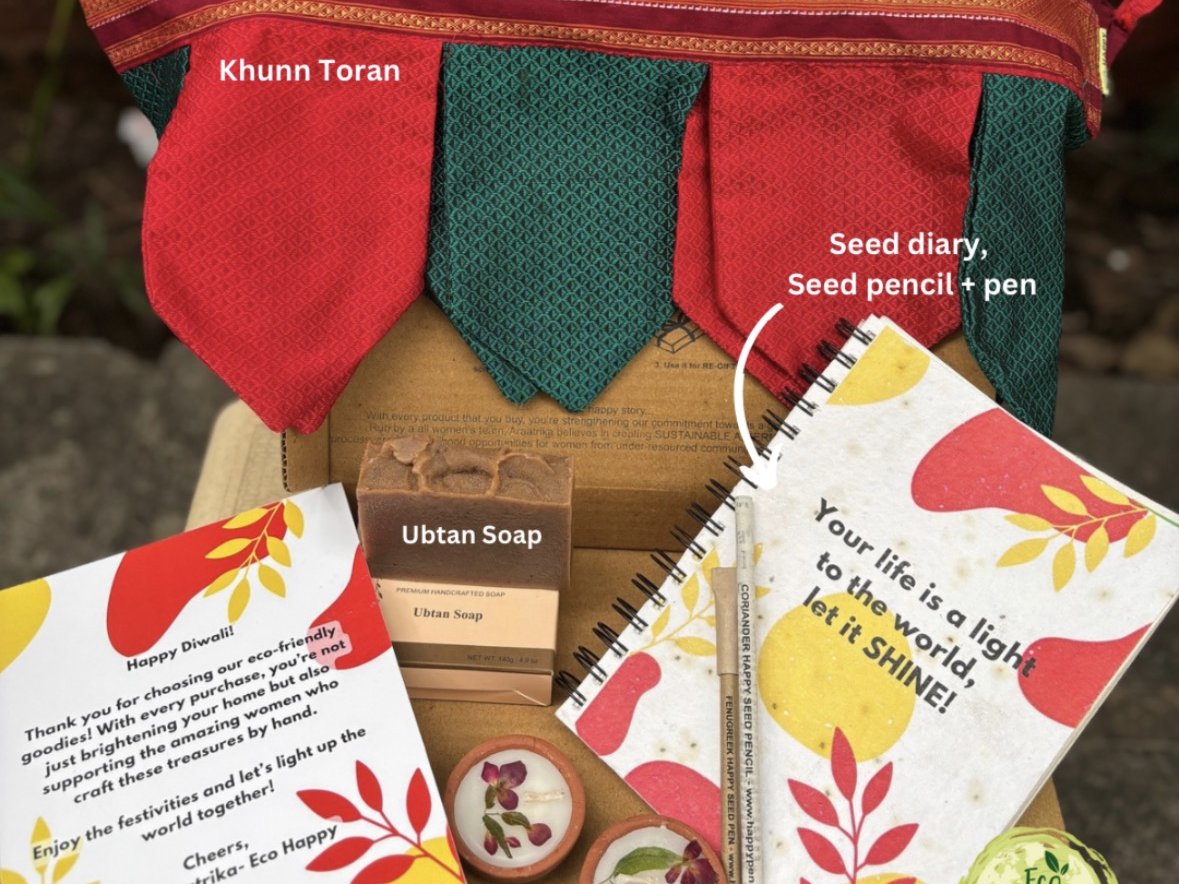
Our Sunshine Hamper is built from seed paper and packed by hand in our Pune workshop specifically for festive gifting, and it’s on sale right now. Like everything we make, it ships under the same rule: we pack orders in paper and use plastic only when it can’t be avoided. For a handful of personal gifts, our seasonal gifting page has festival-ready options you can order over WhatsApp. For bulk, our corporate gifting page covers lead times and pricing, and our impact calculator will run the plastic and CO2e numbers for your actual order quantity against the usual plastic-pen or plastic-wrapped alternative, so the decision isn’t just a guess.
None of this makes any single hamper carbon-neutral, and we wouldn’t claim it does: even a seed-paper hamper still takes water and electricity to make and ship, and still needs a courier to reach your door. It just means the choice is a little more honest than cellophane and a leaf logo, which is about as much as one gift can reasonably promise. The rest gets decided in the week after Diwali, when someone’s sanitation crew finds out what everyone actually bought.
Frequently asked questions
What should I check before buying a 'sustainable' Diwali hamper?
Look for a named material, seed paper, kraft, cloth or steel, rather than just the word 'sustainable.' Check that the packaging actually matches that claim, and whether you can ask the maker a direct question and get a real answer.
Are plantable or seed-based gifts more eco-friendly than regular ones?
They skip the plastic-packaging and disposal questions a regular gift carries, because there is a real second use for the material, planting it, instead of the bin. That is a difference you can point to, not just a label on a box.
Does ordering gift hampers in bulk for employees or clients change the environmental impact?
Yes, mostly by scale rather than by nature. A packaging choice that barely registers for one gift becomes a real material volume at 500 units, and under India's 2026 plastic rules, branded plastic packaging at that volume sits inside a formal EPR compliance chain.
Do large Indian companies have to report on sustainability in a way that touches gifting budgets?
Indirectly, yes. SEBI has required India's 1,000 largest listed companies to file an annual sustainability report (BRSR) since FY 2022-23, and companies above set size thresholds must spend 2% of net profit on CSR under Section 135 of the Companies Act. Neither law names gift hampers, but both put someone inside the company in the habit of asking where money and materials actually go.
What is a good eco-friendly Diwali gift for someone who isn't already interested in sustainability?
Something that works as a nice gift on its own terms first. A hamper like our Sunshine Hamper is a normal, giftable item that happens to be made from seed paper and packed in paper, so the eco-friendly part doesn't have to be the sales pitch to the person receiving it.